


By Benjamin S. Randall
When Josiah Early talks about how he got to Colorado State University, he doesn’t start with a plan, a grand scheme of what Fort Collins had in store with him, or truly even much of an idea – he starts with a moment.
It was in a neonatal intensive care unit, where his newborn daughter, Lily, spent the first weeks of her life. Born with Down syndrome, Lily required constant care – being in the hospital for seven weeks, and during that time, a music therapist came into the room and began to play for Lily. A music therapist is a health professional who uses music-based interventions (playing instruments, singing, songwriting, listening) to help clients, like Lily, meet functional, non-musical goals.
For Early, a lifelong musician who had spent years working with people with disabilities, hearing about the music therapy industry was like a moth drawn to a flame. Something, emphatically, clicked.
“We experienced that music therapist come in and play for Lily, and immediately, I thought ‘That’s a job?’”, Early said. “Let me look into that!”
That moment – quiet, unexpected, and deeply personal – would reshape the very fabric of Early’s future. Later that year, in 2022, Early and his wife, Laura, made a bold decision.
Laura had just finished school and was pregnant with their second child. They packed up their lives and moved – Laura is a midwife and had a job opportunity in Fort Collins – without a clear plan for what would come next. The one thing he knew was that he wanted to pursue music therapy at CSU.
“After that incredible experience in the hospital with the music therapist and Lily, I knew I wanted to pursue music therapy, and I heard about CSU having a great program,” Early said. “I did a bit of preliminary research into that, meeting with the program over Zoom. I was in love with the idea of studying music therapy at CSU.”
But wanting something and affording it are not the same.
“As a first-generation student, college wasn’t really a priority growing up,” Early said. “I had to weigh the cost against my family and finances. I couldn’t make a decision that didn’t make sense for them.”
That’s where donor support changed everything.
Receiving scholarships – including the McDermott Family Scholarship, the William Sharpless Jackson Jr. Scholarship, the Bedell World Citizen Foundation Scholarship, the Osher Re-Entry Scholarship, and the First Generation Award – all of which gave Early the opportunity to say yes to a degree in music therapy at CSU.
“All of a sudden, it was like – whoa. Okay,” Early said, exhaling and smiling.
“This can actually work.”
The financial support didn’t just ease the burden. It made something possible that once felt out of reach: returning to school in his early mid-30s, raising three young children, and building toward a new career in a field he was deeply passionate about.
“At my age, going back for a bachelor’s degree – it felt strange at times,” Early admitted. “But I’m able to provide for my family and work toward something I feel called to.”
Again and again, Early found himself in the same position – uncertain, but willing to say yes and take a leap of faith.
Early’s path has never been linear, but it has always been grounded in service. After high school, he worked a series of jobs before finding his footing in group homes supporting individuals with traumatic brain injuries and developmental disabilities. That work quickly became more than a job – and more important than a job, in Early’s eyes.
“I realized right away, this is what I want to do,” Early said. “I get paid to help people – it just felt like my calling.”
Over the years, he grew into leadership roles, eventually working as a case manager in Larimer County, helping individuals and families navigate complex systems to access care and services. Now, alongside his studies, he continues that work as an adult advocate with the Arc of Larimer County, supporting individuals with disabilities and helping them find their voice.
Early’s commitment to helping others and giving back might be best explained by his personal relationship with religion. Years before he became a father, a decade or so before Lily was born, Josiah had marked his body with a tattoo related to his faith – something that, at the time, felt personal and abstract.
Later on, after his daughter was born, he recognized a familiar shape in a place he hadn’t expected. The symbol widely associated with Down syndrome echoed the mark on his thumb – something he was already carrying with him. This, naturally, wasn’t something he had planned, but to Early – it felt like a quiet kind of continuity…like parts of his life had been preparing him for this long before he knew what this would truly be.
In a moment filled with uncertainty, this felt deeply meaningful — like a quiet reassurance that this was part of his path and something that was meant to be.

Thus, music therapy brings together the two threads that have defined Early’s life: music and service. Early grew up surrounded by instruments – piano lessons, guitars, drums – and found joy in creating and performing. But for him, music has never been about perfection.
“I asked myself: ‘What’s missing from the disability sector?’ – They have transportation, work opportunities, community engagement…music lessons. They were missing music lessons,” Early said. “You go to a music lesson, and you want your child to perform, to be the best musician ever – full stop. That’s not what music is about. It’s about building confidence, building the ability to be proud of yourself in a craft. So, I had the chance to do that for a short time before Lily was born. I was thinking of ways to serve those with disabilities through music before even knowing that music therapy even existed.”
Looking ahead, Early hopes to start a private practice that serves an often-overlooked group: young adults with disabilities who struggle to find community.
His vision goes beyond traditional therapy – combining music with shared experiences like outdoor activities, social connection, and community-building.
“There’s a population that’s being underserved,” Early said. “I want to create something where they feel like they belong.”
For Early, this story isn’t just his – he made it very clear just how integral his family is in every chapter, every page, and downright every word of the book of Josiah Early.
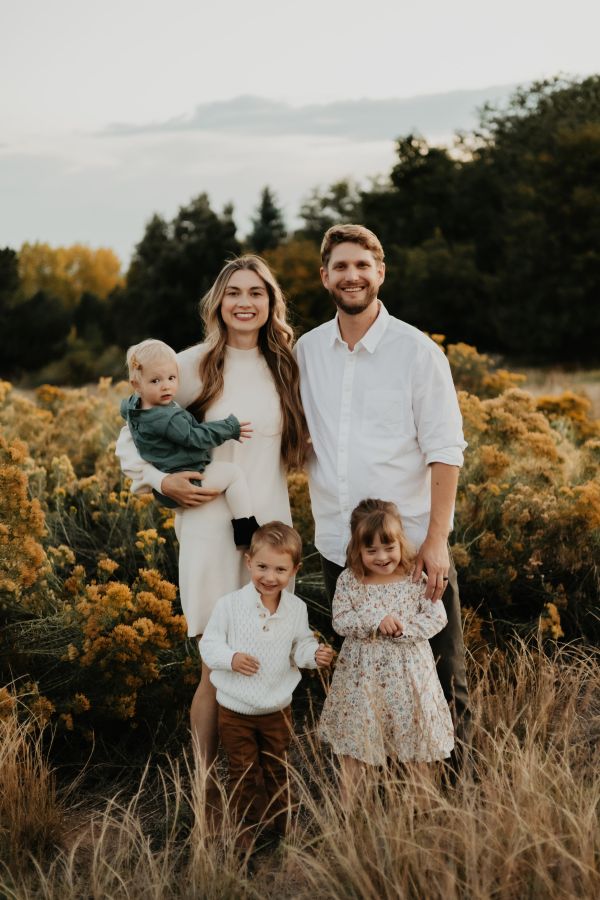
His wife’s support has made it possible to balance work, school, and raising their three children – Lily, Noah, and Selah. Together, they’ve built a life in Northern Colorado rooted in resilience, faith, and a willingness to embrace uncertainty.
“There’s no way I could do any of this without her,” Early said.
As he prepares to walk at graduation this May – Early reflects on the role donors have played in his journey.
“Just, the utmost of gratitude for everyone has helped me financially, physically, and mentally along this journey. Whatever happens next—if I start a practice, if I help people—that’s because someone believed in me.”
For donors, that belief doesn’t end with a scholarship – it continues in the lives their support helps shape, and in the communities those students go on to serve.